Low water
Low water: recognising risks to your supply chain early
Low water is a supply chain risk that does not end with inland shipping itself, but with the companies that source intermediate products via an affected river. SignalChain tracks relevant water level and shipping data and assesses which product groups and companies could be affected – before this turns into an actual delivery disruption.
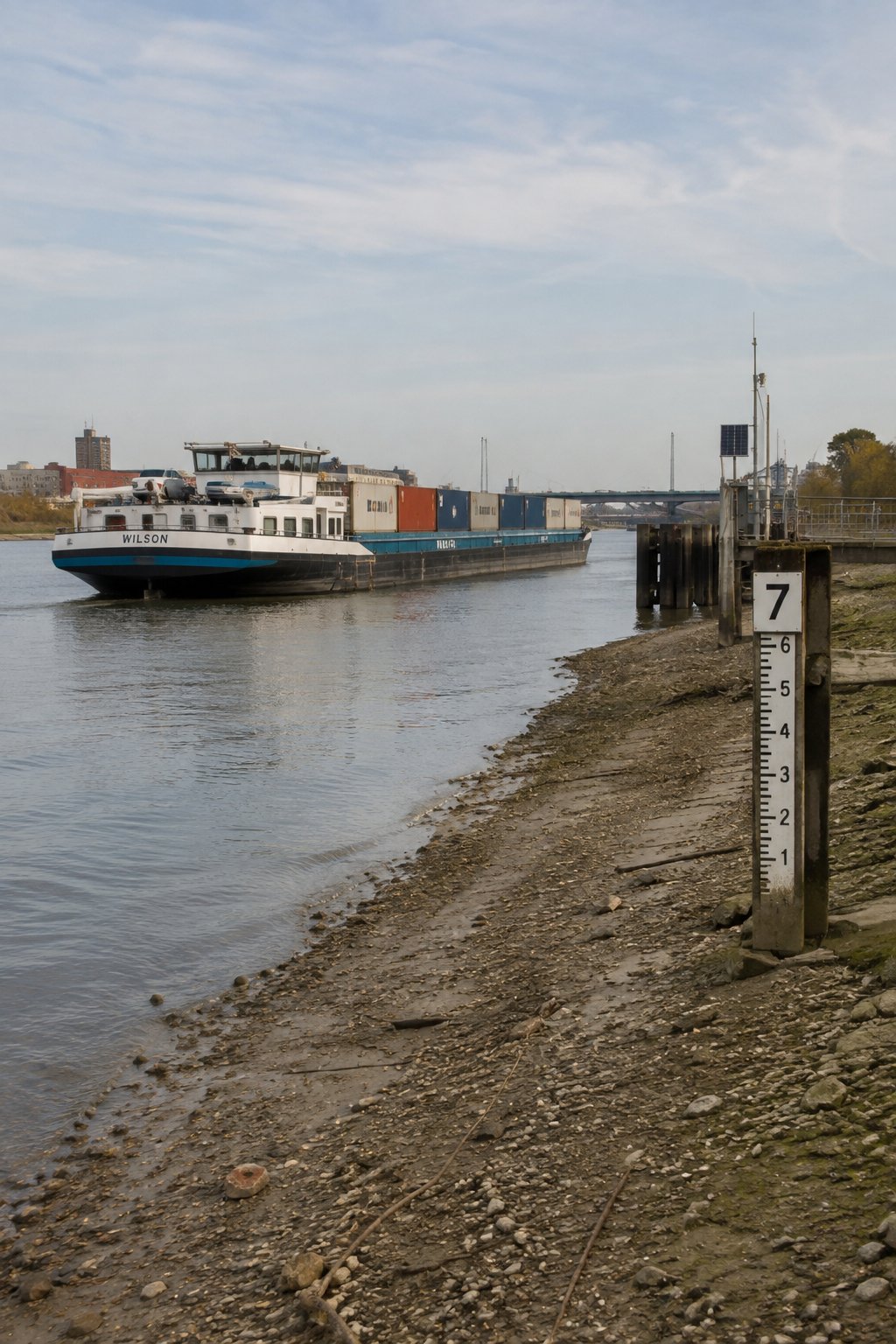
What is a low-water risk for the supply chain?
A falling water level is first of all a hydrological measurement – it only becomes economically significant once it drops below a threshold at which inland vessels can no longer sail fully loaded. What matters here is comparison against the previous value and the season: a water level alone says little without knowing whether it is unusual for the time of year.
The Rhine, Elbe, Weser and the free-flowing Danube are monitored – each with official gauge stations and an economically relevant threshold. Regulated waterways are explicitly not included: a weir holds the water level there, and a low-water rule would suggest a falling draught that does not actually exist there.
Keep track of low-water risks to your supply chain every day
SignalChain monitors relevant external developments every day and notifies you as soon as it becomes relevant for your business.
€299 net/month · notified when relevant · cancel monthly
Which goods flows are particularly affected by low water?
Chemicals and mineral oil
Large volumes are transported by inland vessel year-round and are particularly cost-sensitive when loading is reduced.
Beispiel: A tanker can carry only part of its usual load when water levels are low.
Folge: Higher freight costs or more trips for the same volume.
Coal and building materials
Heavy, low-value-per-tonne cargo is particularly dependent on low transport costs.
Beispiel: Building materials increasingly have to switch to rail or truck during prolonged low water.
Folge: Delayed delivery or higher logistics costs at construction sites.
Agricultural trade and fertiliser
Seasonal goods flows that depend on reliable transport at the right time of year.
Beispiel: A delivery is delayed during a phase critical for sowing or harvest.
Folge: Tight delivery deadlines come under pressure.
Steel and heavy cargo
Bulky, heavy cargo that is particularly efficient by water and can hardly be fully substituted by road.
Beispiel: A plant can no longer receive a heavy-cargo delivery by ship as planned.
Folge: Production planning has to be adjusted or delayed.
How does low water affect the supply chain?
A falling water level rarely leads directly to a supply disruption. Usually the effect runs through several stages:
What remains important is the distinction between the measurement and the consequence: that a water level falls below an economically relevant threshold is a confirmed fact. Whether and how strongly this delays or raises the cost of a specific delivery depends on the cargo, route and stock coverage of the individual company – and is therefore a possible, not a certain, consequence.
Which early indicators should companies monitor during low water?
- Water level on the relevant river
- The current value alone says little – what matters is the distance to the economically relevant threshold.
- Trend relative to the previous value
- Shows whether the situation is worsening or easing.
- Seasonal context
- Indicates whether the current water level is unusual for the time of year.
- Waterway and shipping notices
- Official notices on restrictions to the fairway or cargo loading.
- Freight rate developments
- Rising freight rates on a river stretch are an early sign of capacity constraints.
- Own stock coverage
- Determines how much time remains before a noticeable impact.
- Capacity of alternative transport routes
- Rail and truck capacity as a possible alternative when the waterway is restricted.
Which low-water risk is often recognised too late?
A single water level reading often only becomes news once the media report on a historic threshold. For the supply chain, a different, less conspicuous moment is usually decisive: the day the water level falls below a specific, economically relevant threshold – long before it reaches a record value.
Companies that monitor only their own deliveries often notice the effect only once freight rates have already risen or a delivery has already been delayed. By that point, little room remains for an alternative.
A weather warning reports the water level.
SignalChain assesses which product groups and companies could be affected.
A water level alone says nothing about the impact on an individual company. Only the combination of previous value, direction, seasonal context and affected product group turns it into an interpretable statement.
What can companies do about low-water risks?
- identify relevant rivers and gauge stations for your own procurement
- know the economically relevant threshold for each river, not just the current water level
- check alternative transport routes (rail, truck) and their capacity
- plan stock coverage for product groups dependent on waterways
- monitor early indicators regularly, not only once the water level is already falling
- set escalation thresholds – from what water level does a signal become an internal decision?
None of these measures raises a water level. The goal is time: whoever knows a relevant threshold early has more room to make their own decision before freight rates or delivery times have already changed.
How does an early-warning system for low-water risks work?
An early-warning system for low water systematically monitors the official gauge stations of the relevant rivers, compares the current value against the previous value and the seasonal benchmark, and assesses which product groups and regions could be affected – separated by confirmed measurement and possible consequence.
SignalChain is a daily early-warning briefing for external operational and supply chain risks that also covers low water on the Rhine, Elbe, Weser and the free-flowing Danube. It summarises relevant developments and shows what is confirmed, what could result from it, and what should continue to be monitored. The briefing arrives by email, without an additional dashboard.
SignalChain shows prioritised, evidence-based signals on waterways – not a prediction of exactly when a delivery will arrive. For official shipping and flood warnings, the relevant authorities remain the definitive source; SignalChain does not provide advice for your individual situation.
Keep track of low-water risks to your supply chain every day
SignalChain monitors relevant external developments every day and notifies you as soon as it becomes relevant for your business.
Which rivers does SignalChain cover for low water?
The Rhine, Elbe, Weser and the free-flowing Danube. Regulated waterways are explicitly not included, because a weir holds the water level there.
Where does the gauge data come from?
From official gauge stations of the waterway and shipping authorities – not from press reports.
Does low water only affect inland shipping itself?
No. The actual consequence affects companies that source intermediate products via this route – inland shipping is the channel, not the target of the impact.
From what point does a water level become economically relevant?
Not with every falling water level, but only once it drops below a threshold defined for the specific waterway, at which inland vessels can carry noticeably less cargo.