Low water
Low water as a business and supply chain risk
A falling water level is initially just a hydrological measurement. Low water becomes economically relevant only once inland vessels on a used stretch of the Rhine can carry less cargo, so that raw materials, intermediate goods or energy carriers arrive later, more expensively or not at all by water – regardless of whether a business's own site sits on the river or only depends on it through its supply chain.
Low water on the Rhine can become relevant for businesses when falling levels limit the loading capacity of inland vessels, delaying or raising the cost of transports of chemicals, coal, mineral oil or building materials. What matters is not the news coverage around a low water level, but whether a traceable impact chain reaches the business itself or its supply chain.
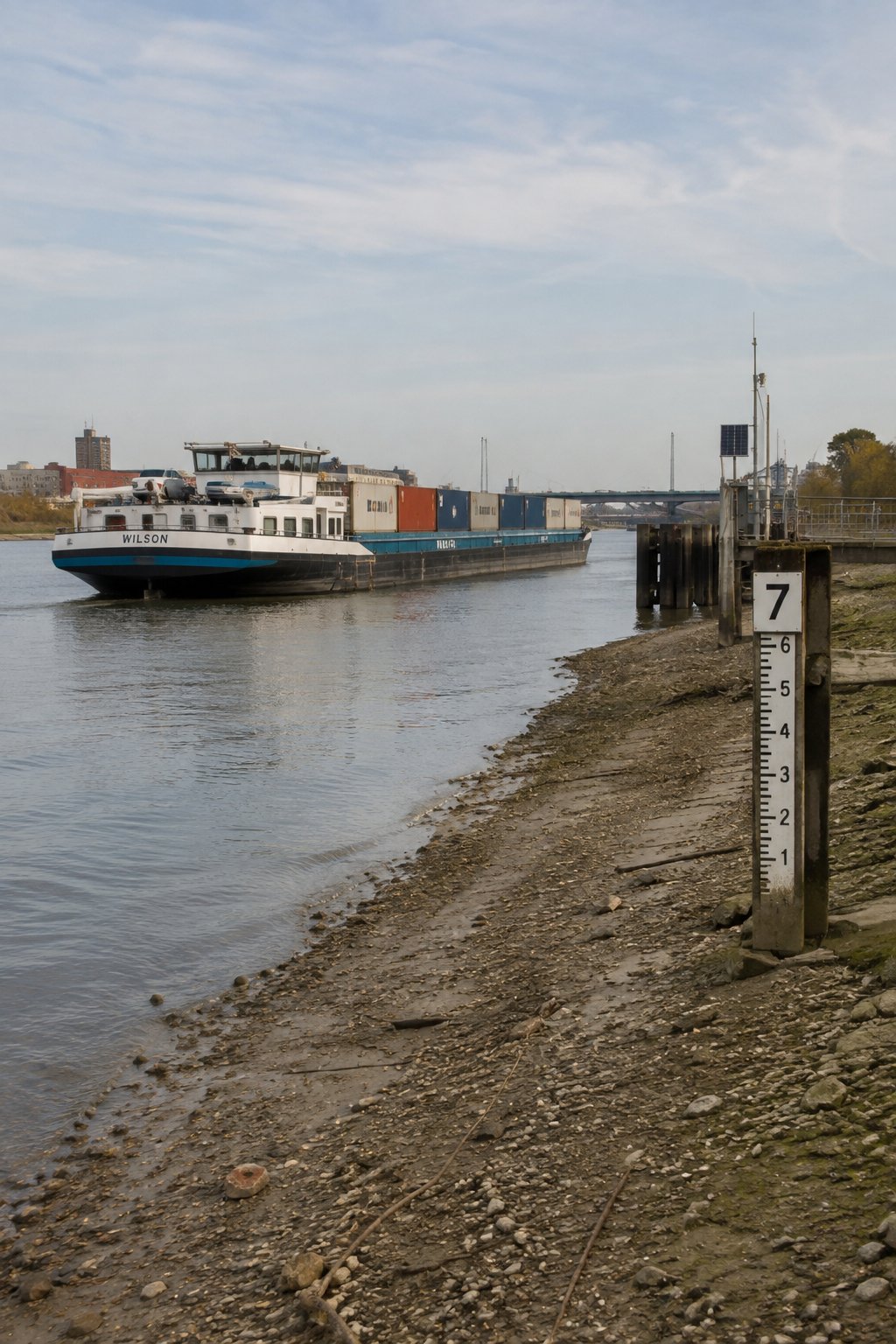
What matters for businesses about low water?
A single water level reading says little on its own. It becomes relevant only when compared with an official reference level, and only if a business or its supplier actually uses inland vessels on the affected Rhine stretch. Once the level falls below the reference value that governs shipping, vessels can only sail partly loaded – carrying less cargo per trip, even though the trip itself remains possible.
This mainly affects goods transported in large volumes and low value density by ship: chemical raw materials, coal, mineral oil products and building materials. Whether an economic consequence results for a specific business depends on its actual transport route, not on the mere existence of a low water level.
Keep low-water risks in view every day
SignalChain monitors relevant external developments daily and gets in touch as soon as something becomes relevant to your business.
What economic consequences can low water have?
- less cargo per inland vessel, requiring more trips for the same quantity
- rising freight rates for transports of chemicals, coal, mineral oil and building materials
- switching to rail or truck with limited spare capacity and higher costs
- delays for time-critical deliveries of raw materials and intermediate goods
- tighter inventory buffers becoming a limiting factor at plants without their own rail link
- rising procurement costs from more expensive or rerouted transport
- possible production throttling at facilities that depend on continuous shipborne supply
How does the economic effect arise?
A typical sequence:
What is documented is the water level itself and its relation to the Gleichwertiger Wasserstand reference; whether a specific delivery or the business itself is affected depends on the transport route actually used and remains a possible, not a certain, consequence.
Which industries are particularly affected by low water?
What is affected is not the Rhine as a region, but the specific transport route of individual businesses: the chemical industry, because large volumes of base chemicals are typically sourced by ship (see early-warning system for the chemical industry); plastics processing, because granulate and intermediate goods often arrive via the same waterways (see early-warning system for plastics processing); the building materials trade, because sand, gravel and cement are transported in large volumes by inland vessel (see early-warning system for building materials); energy-intensive manufacturing, to the extent it sources coal or other energy carriers via the Rhine; and logistics businesses, which either organise inland shipping themselves or must respond to rerouted traffic (see early-warning system for logistics). What matters in every case is the actual link to the river, not industry membership alone.
What early indicators are there?
- Rhine gauges Basel-Rheinhalle and Maxau
- Official water-level readings at central points on the Upper Rhine, the earliest indication of a developing low-water situation.
- Gleichwertiger Wasserstand (GlW2022)
- Official reference level set by the Central Commission for the Navigation of the Rhine, valid until 2031, differing by gauge.
- Gauges further downstream (e.g. Kaub, Duisburg-Ruhrort)
- Show whether a low-water situation is continuing along the river or easing.
- Seasonal comparison against previous years
- Assesses whether a water level is unusually low for the season or matches a typical summer pattern.
- Official discharge forecasts
- Provide a lead time of several days before a critical water level is actually reached.
When does low water actually matter for a business?
Only when a business or an important supplier actually moves cargo on the affected Rhine stretch – as its own shipper or via a forwarder using inland vessels. A low water level on its own, without a transport route in use, has no consequence for the individual business, however prominent the topic is in the news.
Mere proximity to the river is likewise not a reliable indicator: a site directly on the Rhine that is supplied exclusively by truck is economically barely affected by low water, while a business located far away can react sensitively through its upstream supply chain. What matters is the actual route the goods take, not geographic location.
How does SignalChain help?
SignalChain monitors Rhine gauges – including Basel-Rheinhalle and Maxau plus further stations further downstream – against the applicable Gleichwertiger Wasserstand (GlW2022) reference level and assesses whether a current reading is unusually low for the season. The monitoring also covers other waterways besides the Rhine, such as the Elbe, the Weser and the free-flowing Danube, where the same logic – water level against an official reference value – applies.
A striking water level alone does not create an alert level. Only once an impact pattern establishes a link to transports of chemicals, coal, mineral oil or building materials, and the impact chain remains traceable to an affected goods category, does the observation flow into a briefing.
For official hazard and disaster warnings, the relevant authorities remain the definitive source; SignalChain does not provide advice for your individual situation.
Keep low-water risks in view every day
SignalChain monitors relevant external developments daily and gets in touch as soon as something becomes relevant to your business.
How far does SignalChain's low-water coverage reach?
The focus is on Rhine gauges, from Basel-Rheinhalle via Maxau to stations further downstream, each compared against the Gleichwertiger Wasserstand (GlW2022). The Elbe, the Weser and the free-flowing Danube are monitored in addition.
When does low water become relevant for a business?
When a business or its supplier actually moves cargo by inland vessel on the affected stretch and the water level falls below the reference value for shipping – not simply through a general low-water report.
Which industries are particularly affected by low water?
Mainly chemicals, plastics processing, the building materials trade and energy-intensive manufacturing, whose raw materials are often shipped by inland vessel, plus logistics businesses that must organise rerouted transport.
How does this differ from an official gauge reading?
Official gauge readings show the water level itself. SignalChain additionally assesses whether a level is unusual for the season and whether a traceable impact chain exists to goods categories such as chemicals or building materials.
Does SignalChain replace official warnings?
No. For official shipping and gauge notices, the responsible waterway and shipping authorities remain the definitive source.