Traffic closures
Traffic closures as an operational and supply chain risk
A traffic closure is first and foremost an official notice about a closed road, rail line, waterway, or port. It becomes economically relevant only when the closed section is part of a route a business actually uses – regardless of whether the cause is an accident, roadworks, flooding, storm damage, or a strike.
Traffic closures can become relevant for businesses when a closed road, rail line, waterway, or port is part of a transport route actually in use. What matters is not the cause of the closure, but whether a traceable impact chain reaches the business or its supply chain.
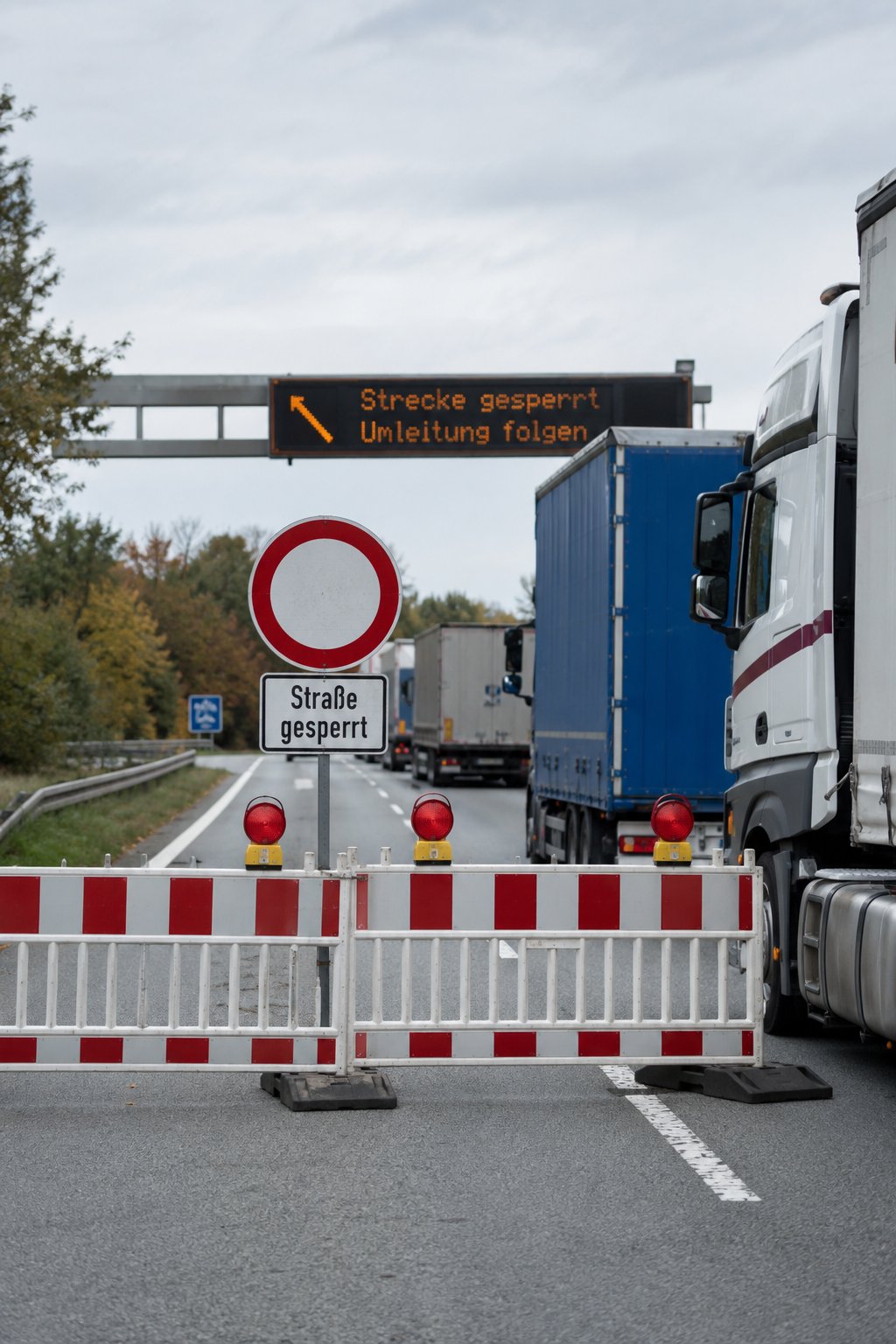
What matters for businesses during traffic closures?
The cause of a closure is rarely the decisive factor for a business – whether an accident, roadworks, flooding, storm damage, or a strike lies behind it changes little about the economic effect. What matters is solely whether the closed section is part of a route a business actually uses for inbound deliveries, outbound shipments, or staff commuting.
A closure on a heavily used route can therefore be inconsequential for a business with no link to that route, while a smaller closure on a rarely used route can upend a time-critical delivery window. What matters is the specific corridor in use, not the general traffic significance of the route.
Keep traffic closures in view every day
SignalChain monitors relevant external developments daily and notifies you as soon as something becomes relevant for your business.
What economic consequences can traffic closures have?
- longer travel times via alternative routes
- higher transport costs from detours or replacement transport
- missed delivery windows and possible contractual penalties for time-critical deliveries
- switching to a different, often more expensive or slower mode of transport
- congestion and knock-on delays even on neighbouring, otherwise unaffected corridors
- bottlenecks in port handling or storage capacity from backed-up shipments
- harder commutes for staff during large-scale closures
How does the economic effect arise?
A typical sequence:
The closure itself and its geographic extent are evidenced; whether it affects a specific route in use, and what costs arise from it, depends on the business's own route and is a possible, not a certain, consequence.
Which industries are particularly affected by traffic closures?
Most affected are businesses whose operations depend directly on the transport route: logistics and freight forwarding, when routes, time windows, and dispatch depend directly on a corridor's passability (see early-warning system for logistics and early-warning system for freight forwarding); port handling, when access roads or adjoining routes are closed (more on this); warehousing, when backed-up shipments tie up extra capacity at short notice; and wholesale trade, when regular deliveries run via a specific corridor. What matters in every case is whether the business's own transport route is affected, not industry membership alone.
What early indicators are there?
- Official road closure reports
- Traffic control centres and state road authorities report closures and roadworks on motorways and main roads on a daily basis.
- Rail infrastructure reports
- Disruption and closure reports from infrastructure operators show whether a rail connection in use is affected.
- Water-level and waterway reports
- PEGELONLINE and the waterway and shipping authority show restrictions for inland waterway routes in use.
- Port status reports
- Operator reports show whether access or handling at a port in use is restricted.
When are traffic closures really relevant for a business?
Only when the closed section is part of a route a business actually uses for inbound deliveries, outbound shipments, or staff commuting – not simply because of the cause of the closure, its prominence in the news, or its geographic proximity to the business's own site. A closure with no link to the business's own corridor is usually economically inconsequential, even if reported widely.
How does SignalChain help?
SignalChain monitors official closure reports for roads, rail, waterways, and ports and assesses whether a business's specific corridor in use could be affected. The assessment relates explicitly to the single, actually used route – not to a blanket commitment covering every transport route.
For official hazard and disaster warnings, the relevant authorities remain the definitive source; SignalChain does not provide advice for your individual situation.
Keep traffic closures in view every day
SignalChain monitors relevant external developments daily and notifies you as soon as something becomes relevant for your business.
Which transport routes does SignalChain monitor?
Official closure reports for roads, rail, waterways, and ports, each related to a business's specific corridor in use – not as blanket coverage of every route.
When is a traffic closure relevant for my business?
When the closed section is part of a route you actually use for inbound deliveries, outbound shipments, or staff commuting – regardless of the cause of the closure.
Which industries are particularly affected by traffic closures?
Mainly logistics, freight forwarding, and port handling with direct route dependence, as well as warehousing and wholesale trade with regular deliveries via a specific corridor.
How does this differ from an official traffic report?
Official reports show the closure itself. SignalChain additionally assesses whether the business's own transport route in use could be affected.
Does SignalChain replace official traffic warnings?
No. For binding traffic and hazard warnings, the competent authorities and operators remain the definitive source.